



Trend trading involves analysing historical price moves to identify and follow the prevailing direction of an asset’s price over a specific timeframe. This guide explores the fundamental concepts, tools and strategies that traders use when implementing trend-based approaches in financial markets.
Trends occur when the price of an asset consistently moves in one direction. This move can either be bullish or bearish, or the price of an asset could move sideways.
The longer a trend is sustained, the greater extent to which it is considered “confirmed,” and the more likely it is that trend traders will open a position.

What Is Trend Trading?
Trend trading is a method of analysing price movements in an attempt to identify the prevailing direction of an asset’s price over a specific timeframe, and to take positions in the market accordingly.
Trend trading relies largely on charting,
- Uptrend: Upward price movement, characterised by higher highs and higher lows.
- Downtrend: Downwards price movement, characterised by lower highs and lower lows.
- Ranging: Sideways price movement, characterised by highs and lows remaining within a defined range.
The term “confirmed trend” is used to explain situations where price movement shows a degree of persistence across multiple indicators or time periods. But it is important to remember that although a trend may be “confirmed”, that doesn’t equate to it continuing in the future.
Case Study: Long-term and short-term equity trends
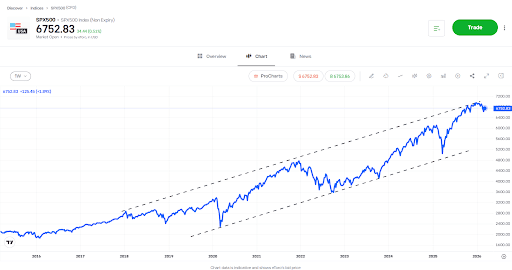
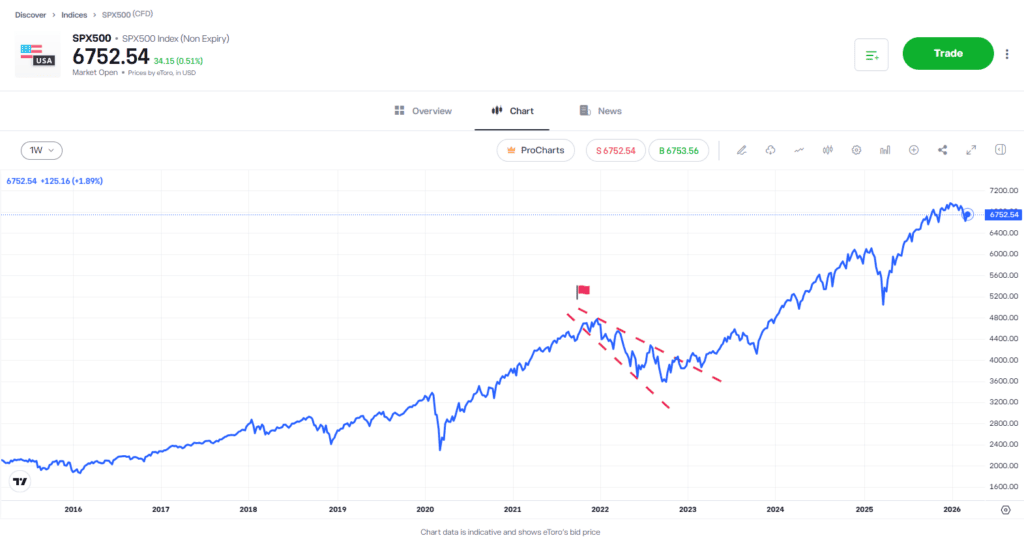
Historical market data demonstrates that while long-term equity indices have shown upward trajectories over decades, shorter timeframes within these periods have contained numerous downtrends and corrections.
The trendlines on the two charts below illustrate how the same equity market index (S&P 500 Index) experienced a long-term upwards trend, but also downwards trends which occurred for a shorter period of time.
How Does Trend Trading Work?
Trend trading works by applying analysis tools to identify price direction over a specific timeframe and then taking a position in the market.
The approach starts by recognising that multiple trends can exist simultaneously across various time horizons. What appears as an uptrend on a daily price chart might be part of a longer-term downtrend on a weekly chart.
The trend trading process typically involves this educational sequence:
- Choose an observation timeframe – Daily, weekly, or monthly charts each reveal different patterns
- Identify direction from price structure – Analyse highs, lows, and overall price progression
- Check if counter-moves look like retracements or potential reversals – Temporary pullbacks versus direction changes
- Use indicators to contextualise direction and strength – Apply technical tools for additional confirmation
- Reassess when conditions change – Markets evolve, requiring ongoing analysis

When identifying trends or managing active positions one crucial aspect of trend trading is understanding the distinction between a retracement and a reversal.
- Retracement: A temporary reversal in the direction of an asset’s price that goes against the prevailing trend, but is short-term in nature with the underlying trend continuing afterwards.
- Reversal: A fundamental, sustained, change in the trend’s overall direction. Breaking through key support or resistance levels and marking a new trend.
Trading Tools for Trend Analysis
Tools which are commonly used to identify established trends include charts, trendlines and technical indicators. Choosing which might be most appropriate can be challenging and in trend analysis – context is everything.
The first step should always be to establish whether a market is ranging or trending upwards or downwards, as this will influence your decision on which tools and indicators to use. There are four broad categories of tools to choose from, as outlined in the table below.
| Tool | Plain-English definition | Conceptual relevance to trend analysis |
|---|---|---|
| Chart patterns | Visual formations created by price movements on a chart | Help identify potential trend continuations or reversals through recognisable shapes |
| Support and resistance | Price levels where buying or selling pressure historically emerges | Act as potential barriers where trends might pause, reverse, or accelerate |
| Technical indicators | Mathematical calculations based on price, volume, or other data | Provide objective measurements to supplement visual chart analysis |
| Timeframe | The period each candlestick or bar represents on a chart | Determines the scope of trends visible and their relative significance |
Trend Trading Strategies
Trend trading strategies outline ways to establish the direction and strength of a trend and points at which to enter into and exit out of positions.
These strategies use various indicators to interpret market
Trendlines
Trendlines are straight lines drawn on charts connecting successive price highs or lows. They connect at least two price points and extend into the future, creating a visual reference for the trend’s potential trajectory.
The features to consider when including them in your strategy planning include:
- Trendlines represent visual boundaries of price movement that traders monitor for potential changes.
- When price approaches these lines, it often represents a decision point where the trend might continue or change.
- A “break” of a trendline occurs when price moves decisively through the line, which can indicate potential trend weakness or reversal.
- False breaks also occur, where price temporarily pierces the line before returning to the trend.
- The significance of a break often depends on factors like trade volumes and the number of times the line has been tested.
Tip: Increased trade volumes reflect more traders are taking a view on whether the trend will continue or reverse.
Moving averages
Moving averages smooth out price data by creating a constantly updated average price over a specific number of periods, helping to identify trend direction by filtering out short-term fluctuations.
Moving averages calculate the mean value of the price of an asset over a given set of time intervals. For example, the 20-day simple moving average (SMA) on a daily price chart demonstrates the average price of an asset over the last 20 days. Key features of moving averages include:
- Shorter averages respond more quickly to price changes.
- Crossovers between different moving averages are commonly interpreted as indications of potential trend changes.
- When a shorter-term average crosses above a longer-term average, this is often viewed as a bullish signal, while the opposite suggests bearish conditions.
- A trend-reversal price move may occur some time before, or after, the moment the cross-over occurs.
- Moving averages are generally considered to be less effective in ranging markets.
Tip: Commonly used SMA periods in trend analysis include 20, 50, and 200 days.
Case study: Accurate SMA crossover signal
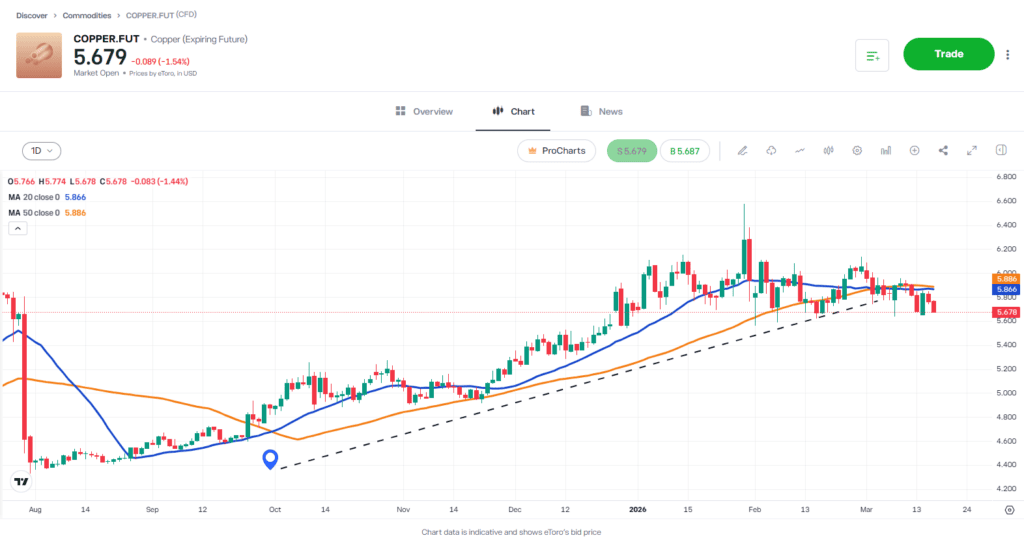
The below price chart for the Copper market illustrates a crossover of the 20 (blue) and 50 (orange) SMAs on the Daily price chart. Following the crossover to the upside, a period of upwards price movement occurred, a move correctly identified by the crossover signal.
RSI (Relative Strength Index)
RSI measures momentum by comparing the magnitude of recent gains to recent losses, producing values between 0-100 that traders interpret as indicators of potentially overbought or oversold conditions.
The RSI calculation produces a reading that oscillates between 0 and 100, with readings above 70 traditionally considered “overbought” and below 30 considered “oversold.”
- These terms describe conditions where price momentum might be extended but does not guarantee an imminent reversal.
- In strong trends, RSI can remain in overbought or oversold territory for extended periods.
Divergence between RSI and price can signal potential trend weakness.
Case study: False RSI trend reversal signal
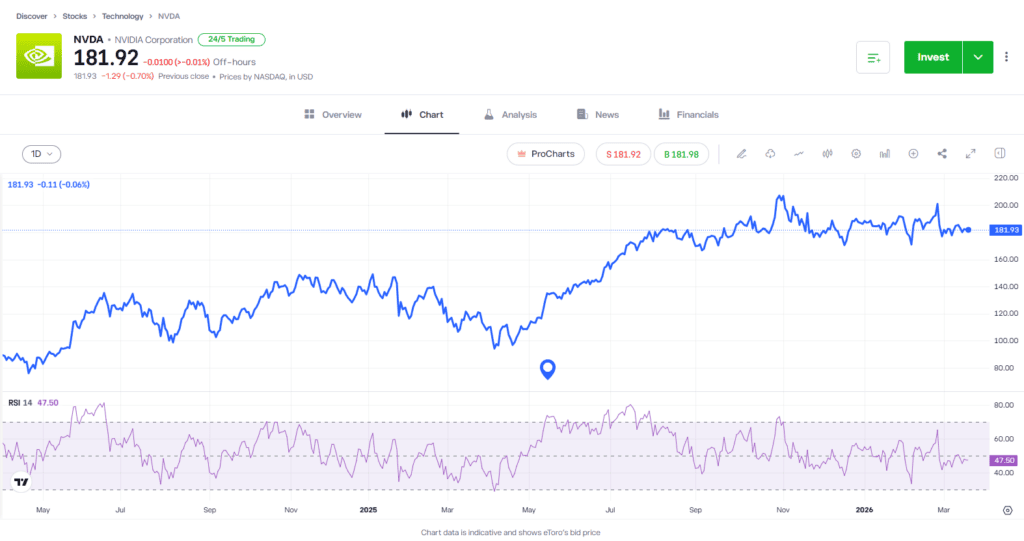
The below price chart for NVIDIA (NVDA) stock shows an overbought RSI signal being followed by continued upwards price movement rather than a reversal. This situation highlights how other factors such as market fundamentals can reduce the effectiveness of technical indicators.
Bollinger Bands
Bollinger Bands add an additional layer of analysis to moving averages and consist of a moving average with two boundary lines that expand and contract based on price
- Bollinger Bands are two additional lines or bands: one above and one below the SMA. These outer bands highlight
standard deviations of price and, statistically speaking, price should trade within these bands most of the time. - Band width serves as a volatility indicator – widening bands suggest increasing volatility while narrowing bands indicate consolidation.
- When price touches or exceeds the outer bands, it might indicate stretched conditions, though in strong trends, price can “walk the bands” for extended periods.
- The squeeze pattern, where bands narrow significantly, often precedes increased volatility and potential breakouts.
Case study: Reading Bollinger Bands
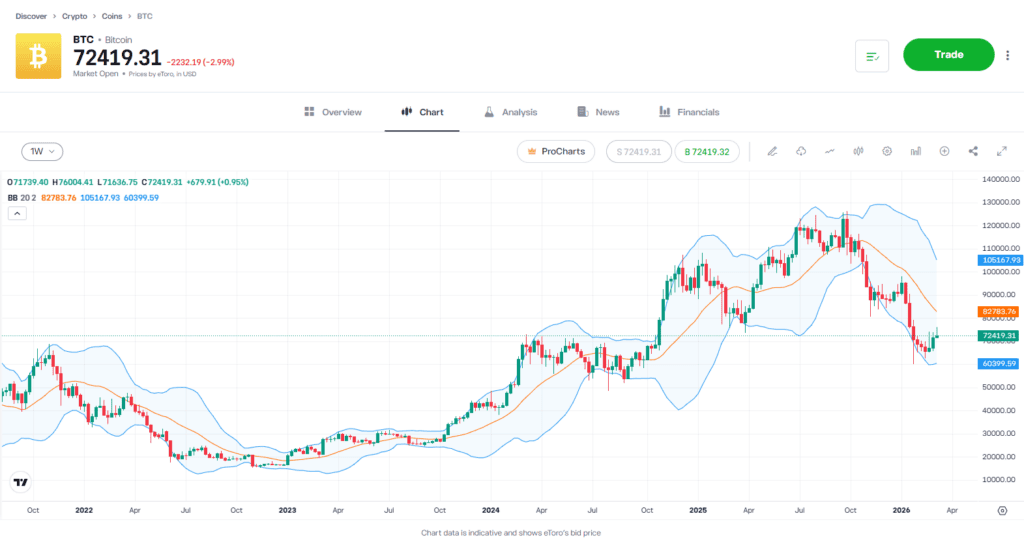
The below price chart for Bitcoin (BTC) illustrates how price often trades near both the higher and lower Bollinger Bands but consistently reverts to be inline with the long-term average. The contractions in the Bollinger Bands can be considered as moments of uncertainty before new trends were formed.
Volume-based indicators
Volume-based indicators like On-Balance Volume (OBV) and Money Flow Index (MFI) incorporate trading activity data alongside price movements to assess the strength or weakness of trends.
The On-Balance Volume (OBV) indicator considers trading activity, as well as price action.
- OBV adds volume on up days and subtracts it on down days, creating a running total that can confirm or question price trends.
- Rising OBV alongside rising prices suggests accumulation / buying
- Falling OBV alongside falling prices indicates distribution / selling
- Divergences between price and OBV could indicate that institutional investors are accumulating or distributing assets before a major trend reversal.
- In theory, the greater the number of active traders, the stronger the signal.
Tip: Different trend indicators can give off contrasting signals at the same time.
The Money Flow Index combines price and volume data to create an oscillator similar to RSI but volume-weighted.
- High MFI readings suggest strong buying pressure.
- Low MFI readings indicate selling pressure.
- MFI helps contextualise whether price movements have substantial participation or might be driven by relatively few market participants.

Indicator categories and applications
It can be useful to categorise the commonly used indicators in terms of what they measure and how their readings might be interpreted.
| Indicator | Category | What it measures | Typical interpretation |
|---|---|---|---|
| Moving Average | Price | Average price over specified periods | Trend direction; dynamic support/resistance |
| RSI | Momentum | Speed and change of price movements | Overbought/oversold conditions; momentum shifts |
| Bollinger Bands | Volatility | Price deviation from moving average | Volatility changes; potential reversal zones |
| OBV | Volume | Cumulative buying/selling pressure | Trend confirmation through volume analysis |
| MACD | Momentum | Relationship between two moving averages | Momentum changes; potential trend shifts |
| Stochastic | Momentum | Price location within recent range | Overbought/oversold; potential turning points |
The multi-indicator approach
This multi-indicator approach involves simultaneously using a range of indicators as part of trend analysis. It works on the basis that generally speaking, the greater the number of indicators that are aligned, the stronger the overall signal that a trend has been formed.
Even greater confidence can be achieved if indicators based on different methodologies align. It could be that a signal is stronger if it is confirmed by trendlines, moving averages, and volume indicators, rather than a series of trendline patterns which base their results on price action alone.
Tip: Remember the old trading floor adage: “The trend is your friend until the end when it bends.”
Final thoughts
Trend trading involves analysing price structure, applying technical indicators, and recognising that different timeframes can reveal different trends simultaneously.
While various tools exist to help identify and confirm trends, they cannot predict unforeseen events, and established trends can reverse without warning.
It is also worth remembering that like all technical indicators, these trend analysis tools are generated using historical data, which limits their effectiveness at predicting future events. But despite its limitations, trend analysis remains a valuable option for determining one of the most crucial aspects of the markets – is a market trending, in which direction, and how long might the situation remain the same.
Visit the eToro Academy to learn more about trading and investing techniques.
FAQ
- What’s the difference between trend trading and momentum trading?
-
While both approaches follow price movements, trend trading focuses on identifying and following the overall direction of price over a chosen timeframe, regardless of the speed of movement. In contrast, momentum trading specifically targets the velocity and acceleration of price changes, often entering positions when price movement accelerates and exiting when momentum slows. Trend traders might hold positions through periods of varying momentum as long as the overall direction remains intact.
- Why might trend traders consider retracements to be a positive factor?
-
Temporary price moves which go against the direction of a longer-term underlying trend can represent temporary, healthy pauses which allow time for trend momentum to build up again. A price dip caused by a retracement or a pullback can also be seen as an opportunity to enter a position at a better price, with “buying the dip” in an uptrend allowing traders to add to existing positions with a more advantageous risk-to-reward ratio.
- What is counter trend trading?
-
Some traders specialise in strategies that track the natural, short-term retracements of a longer term trend. For example, if the underlying trend is upwards, a counter trend trader might open a short position to try and catch an opposite price move.
- Can multiple trends exist on different timeframes?
-
Yes, different timeframes frequently show different trends for the same asset. A stock might simultaneously display an uptrend on the monthly chart, a downtrend on the weekly chart, and sideways movement on the daily chart. This occurs because each timeframe captures different market dynamics and participant behaviours. Traders must specify their intended timeframe to define which trend they’re analysing.
- What is meant by “trend strength”?
-
Trend strength refers to the intensity, momentum, and sustainability of a price move, indicating whether a market trend is likely to continue or reverse. It is calculated using various metrics which include the steepness of price moves on a price chart or the consistency of higher highs and higher lows, or lower highs and lower lows.
This information is for educational purposes only and should not be taken as investment advice, personal recommendation, or an offer of, or solicitation to, buy or sell any financial instruments.
This material has been prepared without regard to any particular investment objectives or financial situation and has not been prepared in accordance with the legal and regulatory requirements to promote independent research.
Not all of the financial instruments and services referred to are offered by eToro and any references to past performance of a financial instrument, index, or a packaged investment product are not, and should not be taken as, a reliable indicator of future results. The availability of all the above-mentioned products and services may vary by jurisdiction and country.
eToro makes no representation and assumes no liability as to the accuracy or completeness of the content of this guide. Make sure you understand the risks involved in trading before committing any capital. Never risk more than you are prepared to lose.