



The Crypto Fear and Greed Index is used to measure the mood of the market, categorising crypto sentiment from extreme fear to extreme greed. This article explores the Index further, considering what it is, how it works, and how it can be used by investors.
The crypto market is known for its emotional swings, with investor sentiment often driving dramatic price movements.
Understanding market psychology has therefore become crucial for anyone navigating the crypto space, and that’s where the Crypto Fear and Greed Index comes in. This sentiment indicator has emerged as a valuable tool for gauging the collective mood of crypto investors, helping traders and investors add context to their market analysis.

What Is the Crypto Fear and Greed Index?
The Crypto Fear and Greed Index is a sentiment indicator that combines market and
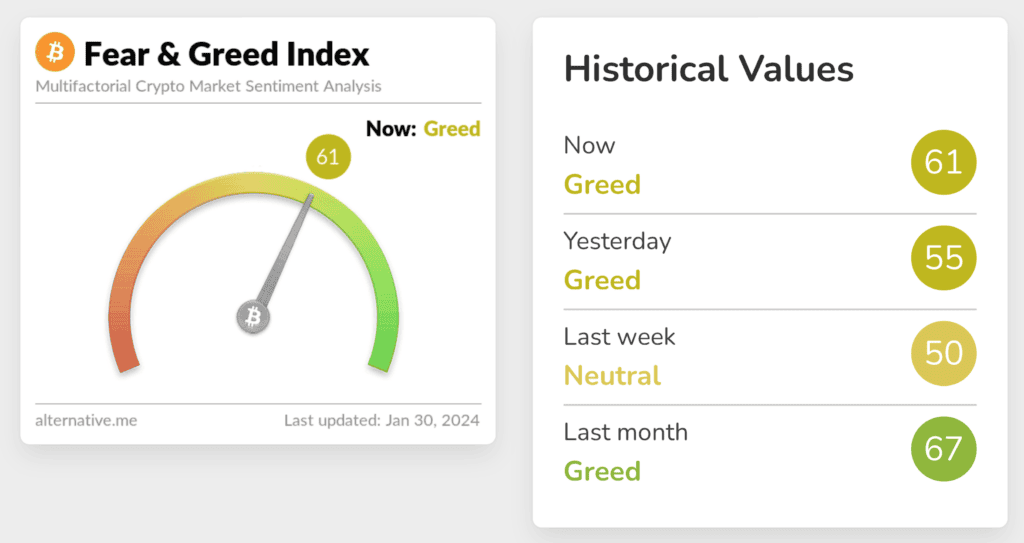
The Crypto Fear and Greed Index serves as a sentiment reading for the crypto market. By aggregating various data points from price movements to social media activity. It then produces a single number that represents the prevailing emotional state of crypto investors.
The Index operates on the principle that excessive fear tends to drive prices lower, while extreme greed can create unsustainable price bubbles.
Unlike traditional
The Crypto Fear and Greed Index doesn’t measure what crypto should be worth; instead, it captures how investors are feeling about the market at any given moment. This distinction is crucial because crypto markets are particularly susceptible to emotional trading, making sentiment analysis especially relevant.
Different providers calculate their versions of the Index using varying methodologies, but the core concept remains consistent: translating complex market emotions into an easily digestible metric.
Tip: The most widely referenced version of the Index updates daily, providing a real-time pulse check on market sentiment.
How Is the Fear and Greed Index Categorised?
The score is grouped into bands that translate a number into a sentiment label, making the reading easier to interpret at a glance. The system divides the 0-100 scale into five distinct bands which helps investors quickly understand market sentiment without needing to interpret raw numbers.
Those bands and their meanings are outlined in the table below.
| Score Band | Label | Neutral Description |
|---|---|---|
| 0-24 | Extreme Fear | Market participants show maximum pessimism; prices often reflect overselling |
| 25-39 | Fear | Investors display caution and risk aversion; selling pressure typically exceeds buying interest |
| 40-60 | Neutral | Market sentiment is balanced; neither fear nor greed dominates trading decisions |
| 61-75 | Greed | Optimism prevails; buying activity often increases as confidence grows |
| 76-100 | Extreme Greed | Maximum optimism in the market; prices may reflect overbuying and excessive risk-taking |
These categories are often associated with certain market behaviours, though correlations aren’t guaranteed. During periods of extreme fear,
How Is the Crypto Fear and Greed Index Calculated?
Most versions combine volatility, trading activity, dominance, and online attention into one daily sentiment score. The calculation methodology varies between providers, but most Fear and Greed indices aggregate multiple data sources to create a comprehensive sentiment picture.
Understanding these components helps investors interpret what drives Index movements and recognise potential limitations, some of which are outlined in the table below.
| Input Factor | What It Reflects | What a Change May Indicate | Key Limitation |
|---|---|---|---|
| Volatility | Market uncertainty and price swings | Higher volatility often suggests increased fear; lower volatility may indicate complacency | Can spike in both directions; doesn’t distinguish between upward and downward movement |
| Volume & Momentum | Trading activity levels | Unusually high volume may reflect strong conviction; low volume might indicate apathy | Volume alone doesn’t reveal buying vs selling pressure |
| Dominance | Large-cap vs small-cap preferences | Bitcoin dominance rising often indicates risk-off sentiment; falling dominance may suggest risk appetite | Doesn’t account for stablecoin flows or new market entrants |
| Social & Search Trends | Public attention and interest | Spikes may indicate | Easily manipulated; includes noise from bots and sensational headlines |
Volatility
Market volatility forms a core component of most Fear and Greed calculations. When prices swing wildly it often reflects emotional trading rather than rational decision-making.
In terms of calculation methodology, the Index will typically compare current volatility levels against 30-day and 90-day averages. This allows current sentiment to be measured in a historical context.
Volatility measures price uncertainty not price direction. This means that when volatility is used as part of a Greed and Fear Index it can be subject to some limitations:
- While high volatility often correlates with fear, it can occur in both market directions.
- Low volatility doesn’t necessarily mean investors are comfortable; it might simply indicate low participation or a market waiting for catalysts.
Tip: A market can remain in “extreme fear” or “extreme greed” for weeks or even months.
Volume and Momentum
Trading volume and
Volume analysis examines:
- The absolute amount of current trading activity.
- How that trading activity compares to recent averages.
Analysis may include momentum indicators such as moving averages and
The challenge with volume-based metrics lies in interpretation. Factors to consider and which introduce more nuance into analysis include:
- High volume might indicate strong conviction in either direction.
- Low volume could suggest either contentment or apathy.
- Context matters significantly when evaluating these inputs.
Dominance
Dominance metrics track investor preferences between established and speculative assets, often reflecting overall risk appetite.
Dominance analysis typically focuses on bitcoin’s (BTC) market share relative to
This metric’s methodology makes assumptions which may limit its effectiveness:
- That bitcoin represents a “safer” crypto investment
- It doesn’t account for
stablecoin movements, which can significantly impact market dynamics without affecting traditional dominance calculations.
Social and Search Trends
Social media sentiment analysis and search trend data provide insights into public attention and discourse around crypto markets. Spikes in social activity often coincide with extreme market movements.
The primary limitations of social metrics are:
- Noise. Bots, coordinated campaigns, and sensational news coverage can skew readings.
- Social sentiment often lags price action rather than leading it, potentially making it a confirming indicator rather than a predictive one.

How Is the Index Commonly Interpreted?
The Greed and Fear Index is commonly used to add sentiment context to market research, not as a stand-alone signal or forecast.
Understanding how to interpret the Fear and Greed Index requires recognising both its value and limitations. The Index provides a snapshot of current market emotion, which can be valuable context for investment decisions, but should never be the sole factor driving trading choices.
Investors could also use the Index to develop a strategy which lines up with the thoughts of legendary investor Warren Buffett. While a critic of crypto, Buffett’s often contrarian approach could have benefited from a tool such as the Greed and Fear Index.
“Be fearful when others are greedy and greedy when others are fearful.”
Warren Buffett
From a trade entry and trade exit perspective the major limitation of the Index is that it oversimplifies market dynamics. Sentiment can remain extreme for extended periods, and attempting to time exact reversals often proves challenging.
Ways to incorporate the Index into your analysis and strategy planning include developing a systematic approach to interpreting the data. This could include:
- Note today’s score and band – Understand the current sentiment reading
- Compare with recent readings – Look at weekly and monthly trends to identify shifts
- Identify driving factors – Determine which inputs are contributing most to the current reading
- Treat as context, not prediction – Use the Index to inform, not dictate, investment decisions
- Combine with broader research – Integrate sentiment data with technical analysis [GLOSSARY: A form of analysis which uses historical market data to try to predict future price movements.], fundamental analysis, and risk assessment

Risk Management
Sentiment indicators may enhance analysis and support discipline but don’t reduce market risk.
The supporting role that the Fear and Greed Index can play in risk management includes helping investors recognise their own emotional biases and identifying periods of extreme market price action.
Some investors also use sentiment indicators such as the Fear and Greed Index when reviewing portfolio concentration. Their approach might be:
- During extreme fear, assess whether their allocation remains appropriate for their risk tolerance.
- During extreme greed, consider whether profits should be realised or positions rebalanced.
Final thoughts
The Fear and Greed Index translates market emotions into a simple metric, but effective investing requires combining sentiment awareness with comprehensive research and disciplined risk management. Sentiment tools have their limits and the Index should not be treated as a prediction tool.
The Index works best as one tool among many in an investor’s toolkit. It can help identify potential market extremes, provide context for price movements, and serve as a reminder about the role of emotions in trading. However, it cannot forecast specific price movements, time market turns with precision, or replace comprehensive investment research.
Visit the eToro Academy to learn more about crypto analysis techniques.
FAQs
- Why measure Crypto Fear and Greed?
-
The crypto markets are known for very emotional behaviour and investor interest in the market as a whole, or specific coins, can be a major factor in determining price levels. Research and analysis tools such as fundamental analysis which are commonly used to value more established assets such as stocks, can be less effective at predicting crypto price moves where sentiment can often be the main factor to consider.
- How often is the Crypto Fear and Greed Index updated?
-
Generally, the Index is updated on a daily basis to allow investors to continuously gauge accurate insights into the market. This allows investors to identify any changes, relative to wider geopolitical events or global news stories.
- Can I analyse a specific cryptoasset with the Fear and Greed Index?
-
Although the Index primarily uses large-cap cryptoassets such as bitcoin (BTC) and ethereum (ETH) to determine the market sentiment for the wider crypto market, investors can indirectly apply its signals to any specific cryptoasset as part of their market research.
- Is it based on Bitcoin only or the wider market?
-
Most Fear and Greed indices focus primarily on bitcoin data, as it represents the largest portion of crypto market capitalisation. However, inputs like social sentiment and search trends often capture broader crypto market activity. Some providers offer separate indices for major altcoins, but Bitcoin-focused versions remain most common.
- Why can Fear and Greed readings differ between providers?
-
Different providers use varying methodologies, data sources, and weightings in their calculations. One might emphasise social media sentiment while another prioritises volatility metrics. These differences can lead to divergent readings, highlighting the importance of understanding which Index you’re following and its specific methodology.