



This article delves into the popularity of the S&P 500 Index, its selection criteria, historical performance, and evaluates its pros and cons, offering insights into the world’s most significant stock market index.
The S&P 500 Index stands as one of the most recognised
The index comprises publicly traded companies from a wide range of sectors and provides a comprehensive snapshot of the American economy and serves as a vital reference point for investors worldwide.
What Is the S&P 500?
The S&P 500 Index is a stock market index that tracks the prices of 500 of the largest companies listed on US stock exchanges. It serves as a widely used benchmark for measuring US stock market performance and as a key barometer for American economic health.
The S&P 500 functions as a market capitalisation-weighted index, meaning companies with larger market values exert more influence on the index’s movements. To qualify for this index, a company must meet several criteria including:
- To be an American company.
- Have a market cap of at least $22.7 billion.
- To be publicly listed on an exchange.
- To have an active market in its shares.
The index spans multiple sectors, from technology and healthcare to financial services and consumer goods, offering broad exposure to the US economy.
Unlike equally-weighted indices where each component receives the same allocation, the S&P 500’s methodology means that the performance of larger companies significantly impacts overall index returns. This structure reflects the actual market dynamics where larger corporations typically command more investor attention and capital flows.
The table below breaks down the key features of the S&P 500 Index.
| Feature | What it means |
|---|---|
| Constituents | 500 large US-listed companies |
| Weighting | Market-cap weighted |
| Reviews | Regular quarterly assessments |
| Common use | Benchmark for stock market performance |
| Sector coverage | 11 major sectors |
The Allure of Index Investing
Index investing offers a way of gaining exposure to a particular area of the financial markets without selecting, buying, and managing individual positions in assets such as stocks.
It has gained popularity as it provides instant
Rather than attempting to identify winning stocks, index investors accept the collective performance of all constituents, which historically has produced steady long-term returns.
The index investing approach appeals particularly to those seeking exposure to broad market trends without extensive research or active management. By tracking an established index like the S&P 500, investors avoid the risks associated with holding concentrated positions in individual companies.

The Evolution and Selection of the S&P 500
The index has continuously evolved to reflect changes in the American economy, such as expanding from 90 to 500 companies 1957.
That process is managed by a dedicated selection committee charged with ensuring the index’s relevancy and representativeness. Their meticulous approach ensures the index accurately represents the large-cap segment of the US market and considers factors such as:
- Domicile
- Market capitalisation
- Financial viability
- Percentage of shares publicly available
- Liquidity and trading volume
- Sector classification
- Corporate governance standards
This selection process ensures the integrity of the index and other reasons why they matter to investors are outlined below.
| Factor mentioned | Plain-English meaning | Why it matters for an index |
|---|---|---|
| Market capitalisation | Total value of a company’s shares | Ensures inclusion of substantial companies |
| Liquidity | How easily shares can be traded | Enables smooth index tracking |
| Trading volume | Number of shares changing hands | Indicates active investor interest |
| Quarterly reviews | Regular assessment of constituents | Keeps index current and representative |
The index undergoes regular reviews and rebalancing. This can include stocks being withdrawn or included in the index and the weighting given to existing members being adjusted in line with market performance.
Case Study #1: What happens when a company is added or removed
When a company joins the S&P 500, there are ramifications for index-tracking funds which follow the S&P.
- Company A is added to the S&P 500 Index.
- S&P tracker funds buy stocks in Company A in the open market to ensure their position matches that stock’s index weight.
- The timing and scale of these adjustments vary based on market conditions and fund management approaches.
Conversely, when Company B is removed from the S&P, index funds sell their holdings.
This rebalancing process helps maintain the index’s representation of the large-cap US market. It can result in the prices of stock A and B adjusting following considerable buying and selling pressure in the open-market.

A Global Market Snapshot in One Index
While focused on US-listed companies, the S&P 500 provides exposure to global business operations through multinational corporations. Many of the stocks which make up the index have significant international operations and span a multitude of industrial sectors.
The index offers investors broad exposure to the global economy, not just domestic US economic activity. Technology giants, pharmaceutical companies, and consumer brands within the index often derive significant portions of their income from markets in Europe, Asia, Latin America and emerging markets.
The list of the top-10 weighted stocks in the S&P 500 Index will often contain these global brands:
- NVIDIA Corp (NVDA) – Information Technology
- Apple Inc. (AAPL) – Information Technology
- Microsoft Corp (MSFT) – Information Technology
- Alphabet Inc. (GOOGL/GOOG) – Communication Services
- Amazon.com Inc. (AMZN) – Consumer Discretionary
- Broadcom Inc. (AVGO) – Information Technology
- Meta Platforms Inc. (META) – Communication Services
- Tesla Inc. (TSLA) – Consumer Discretionary
- Berkshire Hathaway Inc. (BRK.B) – Financials
- Eli Lilly and Co (LLY) – Health Care
The global reach of the index means that investors gain indirect exposure to worldwide economic trends through a single US-based index. However, it’s important to note:
- The S&P 500 primarily represents large US-listed companies.
- It doesn’t provide the same diversification as a truly global index that includes companies from multiple countries and regions.
- Exposure across sectors will depend on the weighting applied to different stocks.
Tip: Understanding the international revenue exposure of S&P 500 companies can help investors assess their true geographical diversification.
If It’s Good Enough for Buffett
Warren Buffett has publicly advocated for index fund investing, particularly for those without the time or expertise for individual stock selection.
The world-famous investor’s suggested approach involves consistently investing in index funds, particularly the S&P 500. He famously emphasised this approach in his advice to investors.
“Consistently buy an S&P 500 low-cost index fund. I think it’s the thing that makes the most sense practically all of the time.”
Warren Buffett
Buffett’s perspective is based on a variety of factors, including:
- Performance: Actively managed funds can struggle to outperform the index after accounting for fees and expenses.
- Cost: Achieving market returns through a low-cost index fund has the potential to produce better results than attempting to beat the market through active selection.
- Convenience: Using tracker funds is easier and cheaper than managing individual stock positions.
- Diversification: Although market giants such as NVIDIA make up a relatively significant part of the S&P 500 Index the presence of 500 different companies reduces concentration risk.
This viewpoint has influenced countless investors to consider index funds as a core component of their long-term investment approach. While Buffett himself champions active value investing, the alternative option of index investing recognises that more bespoke strategies require significant time, skill, and resources that may not be available to all investors.
The Rise of Index Investing
For index investors, the S&P 500 is often the prime choice. It’s not just a measure of the US economy, but a barometer of global economic trends, housing both American and significant international companies. Its diversified nature, across 11 different sectors encompassing tech, healthcare, financial services, and more, offers investors a comprehensive market snapshot.
Index investing has transformed from a niche strategy to a mainstream approach embraced by millions of investors worldwide.
The growth of the sector reflects several key advantages that have resonated with both individual and institutional investors. These include:
- Lower costs compared to actively managed funds
- Transparency of holdings
- Performance inline with a benchmark
- Relatively low minimum investment size
Few investment managers consistently outperform indices, bolstering the appeal of index investing, despite some inherent limitations.
This democratisation of investing has enabled broader participation in financial markets, allowing investors of all sizes to access diversified portfolios previously available only to large institutions.
Why the S&P 500 Stands Out
Among various indices, the S&P 500 has emerged as a preferred benchmark due to its comprehensive market coverage and long track record. This is partly due to the index’s methodology of market-cap weighting which means it automatically adjusts to reflect changing market dynamics.
It’s not just a measure of the US economy, but a barometer of global economic trends with there being a range of factors which contribute to its prominence:
- Broad sector representation across the economy
- Long historical data enabling performance analysis
- High liquidity facilitating easy trading
- Widespread use as a performance benchmark
- Regular maintenance ensuring continued relevance
A Journey Through Time — S&P 500’s Performance
Past performance is not a predictor of future results but historical data shows that despite some notable short-term corrections in the S&P 500 averaged annual returns above 10% over the medium-term.
A breakdown of S&P 500 Index returns over different time periods and up to 2025 is provided below, it assumes reinvestment of dividends:
- Last 5 Years – 15.0%
- Last 10 Years – 15.6%
- Last 20 Years – 10.9%
While certain years saw significant drops, the overall long-term trend showcases its reliability and robustness as an investment option which is a reflection of global economic growth.
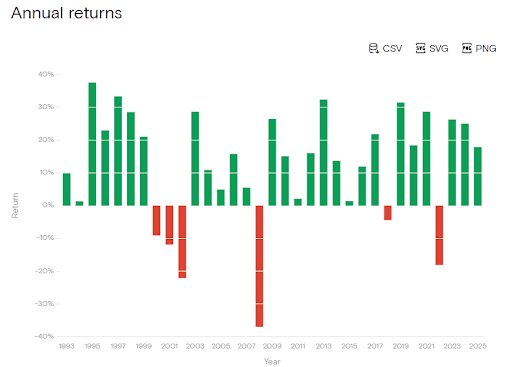
Source: Curvo
These examples are simplified and for illustrative purposes only; actual liability depends on personal circumstances and local laws.
Case study #2: Total return vs price return
Understanding the distinction between price return and total return is crucial when evaluating performance. Price return reflects only the change in the index level, while total return includes reinvested dividends, providing a more complete picture of investor returns.
Consider a simplified example:
- The S&P 500 price level rises from 4,000 to 4,200 points over a year.
- This represents a 5% price return.
- Companies in the index paid dividends totalling 2% during that period.
- If these were reinvested, the total return would be 7%.
These examples are simplified and for illustrative purposes only; actual liability depends on personal circumstances and local laws.
Over multiple years, this difference

Spotlight on Major Stocks
Market capitalisation weighting creates concentration in the largest companies, which can significantly influence index performance.
In early 2026, Nvidia alone had more influence on the index’s performance than the entire healthcare sector, or than services, real estate, and materials combined.
This creates what is called concentration risk – an excessive dependence on a few companies. The largest constituents, often technology companies, can account for a substantial portion of the index’s total value.
This concentration effect means that movements in a handful of stocks can drive significant index changes. While this can amplify gains during periods when large-cap stocks outperform, it also means the index may be more vulnerable to sector-specific risks than its 500-company composition might suggest.
The key terms to know to develop a better understanding of this situation are outlined below.
| Concept | What it means | Common implication |
|---|---|---|
| Market-cap weighted | Larger companies have more index influence | Top holdings drive performance |
| Concentration | Few stocks represent large index portion | Reduced diversification at the top |
| Sector tilts | Some sectors become overrepresented | Index may not reflect broad economy equally |
| All companies receive same allocation | Different risk/return profile |
Case Study #3: Weighting impact illustration
Imagine an index with just two companies:
- Company A worth $100 billion.
- Company B worth $10 billion.
- Total index value = $110 billion.
In a market-cap weighted approach:
- Company A represents about 91% of the index (100/110)
- Company B represents 9%.
- If Company A’s stock rises 10%, the index gains approximately 9.1%.
- If Company B rises the same 10%, the index gains only 0.9%.
This illustrates how larger companies have outsized influence on market-cap weighted index performance.
Tip: Consider how concentration in top holdings might affect your overall portfolio structure if investing in the S&P 500.
Accessing the S&P 500: Investment Instruments
Various financial products enable investors to gain exposure to the S&P 500 without going to the trouble of purchasing hundreds of individual stocks. Index funds and ETFs are two of the most popular.
- Index funds: Aim to replicate the index’s performance by holding the constituent stocks in proportions matching their index weights. Trade once daily at
net asset value (NAV) . - ETFs: Also aim to replicate the index’s performance by holding the constituent stocks in the right proportions. ETFs trade throughout the day with real-time price fluctuations, like individual stocks.
Tip: Some funds use full replication, holding all 500 stocks, while others may use sampling techniques for smaller positions.
Assessing Valuation and Risks
Understanding valuation metrics helps contextualise the index’s current pricing relative to historical levels.
The
Higher P/E ratios suggest more expensive valuations in relation to earnings because investors are optimistic about growth expectations. But like all valuation metrics it is important to also consider context and apply it in your analysis with care.
Tip:
Final thoughts
The S&P 500 represents more than just an index; it’s a mirror reflecting the multifaceted nature of the global economy. Its journey over multiple decades to the present day demonstrates not only its ability to adapt and evolve, but also its capacity to potentially offer steady, long-term growth.
Warren Buffett’s advocacy for the S&P 500 underscores its appeal as an investment choice, particularly for those seeking a simple, effective strategy that historically outperforms active trading.
While mindful of its sector biases, valuation, and inherent market risk, investors can approach this index as a cornerstone of a well-rounded, informed investment portfolio.
Visit the eToro Academy to learn more about index trading and investing.
FAQs
- What sets the S&P 500 apart from the Dow Jones Industrial Average (DJIA) and the Nasdaq?
-
The S&P 500’s distinction lies in its broader market coverage, featuring 500 of the largest US companies across various sectors, unlike the limited data pool of the DJIA 30 and the Nasdaq’s heavy weighting towards tech-stocks. This diversity provides a more comprehensive snapshot of the US economy, making it a preferred index for many investors and analysts.
- How does the S&P 500’s performance typically compare to other investment options?
-
Historically, the S&P 500 has offered competitive returns compared to other investment avenues. Its diverse portfolio of large-cap stocks often yields stable growth, making it a benchmark for evaluating other investments’ performance.
- Can individual stocks within the S&P 500 outperform the index as a whole?
-
Yes, individual stocks in the S&P 500 can and do outperform the index. However, picking stocks involves higher risks, as selecting individual winners requires in-depth research and market understanding. The performance of individual stocks can be significantly influenced by company-specific factors and industry trends.
- How long has the S&P 500 Index been in operation?
-
The modern 500-stock composite index known as the S&P 500 Index was officially launched in 1957 to provide a broader, real-time measure of the U.S. stock market. Earlier indices which could be considered part of the history of the S&P 500 include a 233-stock index launched in 1923 and a 90-stock daily index founded in 1926. This extensive track record is useful for investors who take a long-term view on investing.
- Who are Standard & Poors?
-
Standard & Poor’s (S&P), now primarily known as S&P Global, is an American financial intelligence company and one of the “Big Three” credit rating agencies. They provide independent credit ratings, market research, and benchmarks, most notably maintaining the S&P 500 Index.
This information is for educational purposes only and should not be taken as investment advice, personal recommendation, or an offer of, or solicitation to, buy or sell any financial instruments.
This material has been prepared without regard to any particular investment objectives or financial situation and has not been prepared in accordance with the legal and regulatory requirements to promote independent research.
Not all of the financial instruments and services referred to are offered by eToro and any references to past performance of a financial instrument, index, or a packaged investment product are not, and should not be taken as, a reliable indicator of future results. The availability of all the above-mentioned products and services may vary by jurisdiction and country.
eToro makes no representation and assumes no liability as to the accuracy or completeness of the content of this guide. Make sure you understand the risks involved in trading before committing any capital. Never risk more than you are prepared to lose.
eToro AUS Capital Limited ACN 612 791 803 AFSL 491139. OTC Derivatives are leveraged financial products and considered speculative. OTC Derivatives may not be suitable for all investors. You don’t own the underlying assets. You risk losing all of your investment. This information is general only and has been prepared without taking your objectives, financial situation or needs into account. Consider our Product Disclosure Statement (PDS and TMD). See full disclaimer.
EU disclaimer: CFDs are complex instruments and come with a high risk of losing money rapidly due to leverage. 76% of retail investor accounts lose money when trading CFDs with this provider. You should consider whether you understand how CFDs work and whether you can afford to take the high risk of losing your money.