



Understanding how technical indicators work and when to apply them forms the foundation of technical analysis in financial markets. This is how to use these tools to leverage the power of mathematical and statistical formulae and analyse price charts to gain an up-to-date view on market conditions.
Technical indicators are mathematical calculations applied to historical market data that help traders identify patterns, trends, and potential trading opportunities. They have the potential to provide an indication as to the direction in which a price might move.
What Are Technical Indicators?
Technical indicators are tools based on calculations of historical price and trade volume data that can be used in analysis to interpret market conditions.
These indicators transform raw market data into visual tools such as lines and monitors which can be applied onto a price chart to gain greater insight into market dynamics, and they fall into three main categories:
- Trend-following (moving averages)
- Momentum (RSI, stochastics)
Volatility (Bollinger Bands)
Technical indicators process historical market data through specific mathematical formulae to present different perspectives on price action. Though it is important to remember that as they are based on historical data they describe past behaviour rather than predict future movements.
Tip: A key concept to understand is the
Indicators serve as interpretive tools that help traders understand current market conditions by highlighting patterns that might not be immediately visible in raw price charts. Think of them as different lenses through which to view the same price data; with each indicator emphasising different aspects of market behaviour.
Popular Tools and Indicators
There are hundreds of technical indicators available to traders, but the most popularly used indicators tend to provide a simple, but useful, interpretation of key metrics such as price and trade volume.
Understanding what they enable is the first step towards incorporating them into your trading strategy. With commonly used indicators including trend indicators which show direction, momentum indicators which reveal strength, and volatility indicators display price dispersion.
Understanding the main categories of indicators helps traders select appropriate indicators for different market conditions. Here’s how the primary indicator families break down:
| Family | Example indicators | What it describes | Common limitation |
|---|---|---|---|
| Trend | Moving averages, | Direction and smoothing of price movement | Lag behind price changes |
| Momentum | RSI, Stochastic | Speed and strength of price changes | False signals in ranging markets |
| Volatility | Bollinger Bands, | Degree of price variation | Sensitive to parameter settings |
| Volume | Trading activity levels | Less reliable in thin markets |
Moving Averages
Moving averages smooth price data by calculating the average price over a specific number of periods, revealing underlying trends by filtering out short-term price noise.
For example, the 20-day simple moving average (SMA) on a daily price chart demonstrates the average price of an asset over the last 20 days. For a 5-day SMA, the underlying formula adds the closing prices of the last 5 days and divides by 5.
Case Study – Simple moving average (SMA): If a stock’s closing prices over 5 days are: $10, $11, $10.50, $11.50, $12 The 5-day SMA reading on the fifth day = (10 + 11 + 10.50 + 11.50 + 12) ÷ 5 = $11
Tip: Choose your MA timeframe carefully. Day-traders might use hourly MAs while swing traders focus on daily or weekly periods.
An alternative approach is offered by the Exponential Moving Averages (EMA) which gives more weight to recent data points. This makes EMAs more responsive to recent price changes, though both types of moving average serve to identify trend direction.

Bollinger Bands
Bollinger Bands consist of a moving average with two
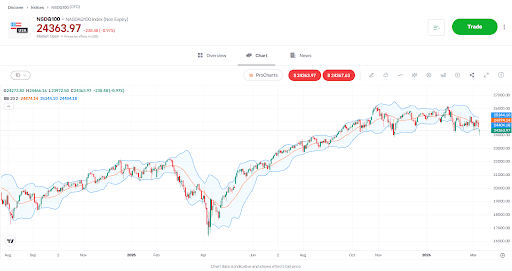
These bands typically use a 20-day moving average as a central line. Above and below the line are two tracing bands in standard deviation width. The upper band is calculated by adding two standard deviations to the moving average, while the lower band subtracts two standard deviations.
The outer bands highlight standard deviations of price and, statistically speaking, price should trade within these bands most of the time.
The width of Bollinger Bands provides crucial information about market conditions.
- Widening Bollinger Bands indicate increased price volatility and that buyers and sellers are more active. This could signal that a breakout of the range could be imminent.
- Narrow or narrowing bands suggest low volatility and potential consolidation.
The chart below tracks the widening and narrowing of the Bollinger Bands for the Nasdaq 100 Index (NSDQ100) and the way that
Oscillators
Oscillators are
- Oscillator readings are typically graded as being between 0-100.
- They fluctuate within a bounded range helping identify when buying or selling activity in markets may be overextended.
- By oscillating within a fixed range, these indicators make it easier to identify extreme conditions.
- Work on the principle that momentum often changes before price.
- Potentially useful for spotting potential reversal points.
When oscillator readings approach the upper or lower boundaries of their range, it suggests that the current price move may be losing steam. However, markets can remain in extreme conditions longer than expected, especially during strong trends.
Relative Strength Index (RSI)
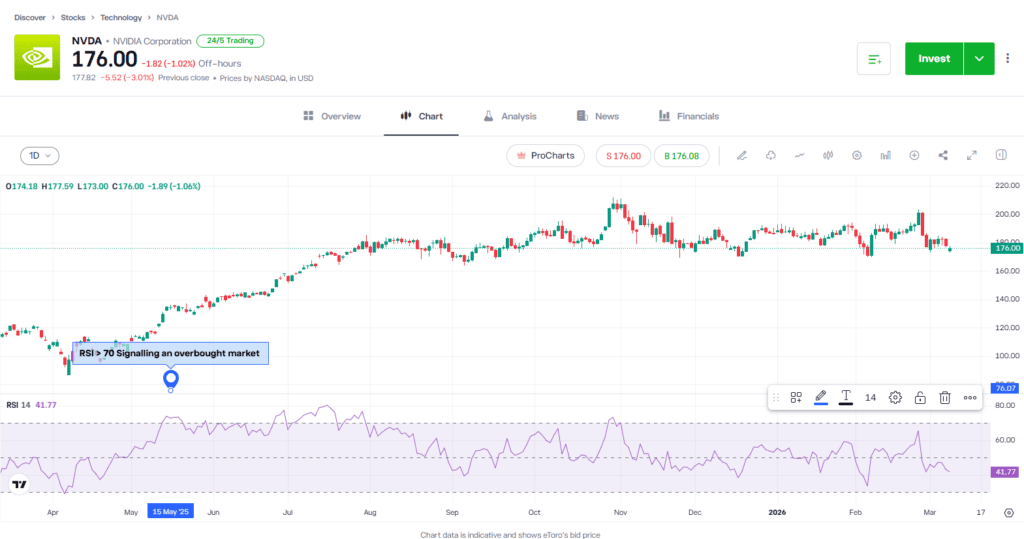
The Relative Strength Index (RSI) is an oscillator indicator that compares the magnitude of an asset’s recent gains, relative to its losses. It presents its findings as an index score ranging between 0 and 100.
- RSI readings above 70 are commonly interpreted as signalling a market is
“overbought” - Readings below 30 that a market is
“oversold” .
Case Study – NVIDIA RSI overbought : The price chart below identifies a moment when the RSI on the 1Day price chart for NVIDIA (NVDA) stock is over 70 and signaling the market is overbought on that timeframe.
In this instance the signal fails and the stock price continues to rise rather than fall, demonstrating how investor sentiment and exuberance can be more important determinants of price action than technical indicators.
It’s crucial to understand that overbought and oversold are interpretations, not guarantees. Markets can remain overbought or oversold for extended periods during strong trends.
Tip: The typical default parameters for the RSI calculation uses 14 periods, though these timeframes can be overridden manually.
Stochastics
Stochastics compare a closing price to its price range over a given period, operating on the theory that prices tend to close near extremes before reversing.
Stochastics adopt a similar approach to oscillators but give greater weight to the closing price of any time interval. In theory, if the closing price in a market is nearer to the peak of the intraday range, it is a sign of further upward price momentum, and vice versa. The indicator produces two lines – %K (the main line) and %D (a moving average of %K).
The stochastic calculation examines where the current close sits within the recent high-low range. A close near the period’s high suggests buying pressure, while a close near the low indicates selling pressure. This relationship between closing position and range extremes forms the basis for momentum interpretation.
Ranging Markets Tools and Indicators
Range-bound markets oscillate between horizontal

When price moves across the chart, rather than forming an upward or downward trend, favoured indicators will be those which highlight when price reaches extremes within an established range. These indicators which offer an insight into the possibility of the market continuing to experience mean-reversion include:
- Oscillators such as RSI.
- Stochastics.
- Bollinger Bands which visually display the range boundaries.
- Volume indicators that can signal the end of the ranging period and a breakout.
Tip: Traders must watch for false breakouts and genuine breakouts and learn how to distinguish between these scenarios.
Trending Markets Tools and Indicators
Analysis of trending markets which exhibit directional momentum can involve applying indicators such as moving averages which reveal the trend direction, and momentum oscillators that gauge trend strength.
- Moving averages are primary tools for identifying trend direction and potential entry points.
- SMA parameters can be customised into versions displaying different lookback periods, such as the 20-day or 50-day MA.
- Momentum indicators help assess whether the trend has strength to continue or is losing steam.
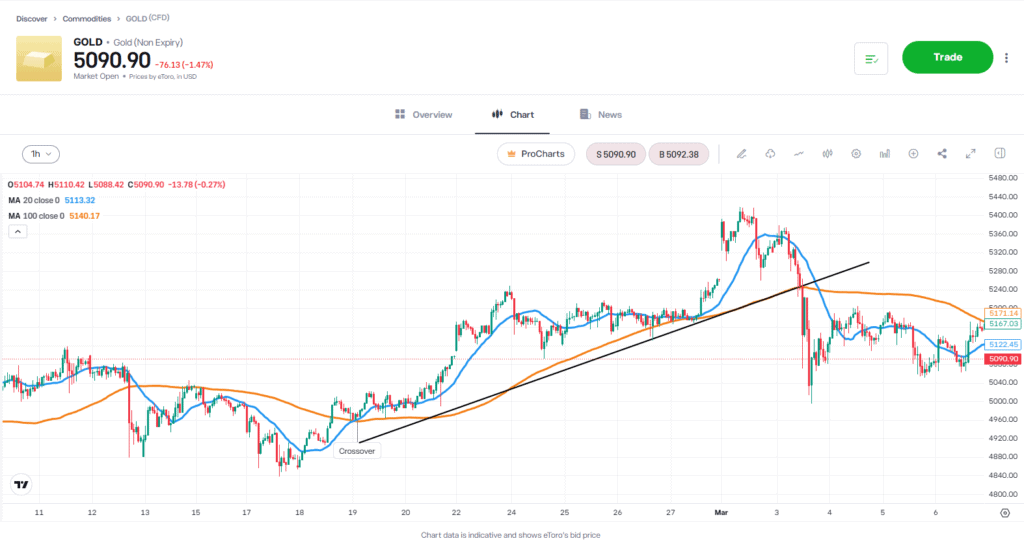
Crossovers between different period moving averages are often seen as signals of trend changes.- Work best in established trends and can produce false signals in choppy markets.
Case Study – MA Crossover: The example below taken from the Gold market illustrates an upwards crossover of the (blue) 20-day SMA and the (orange) 100-day SMA. In this instance the crossover provided an accurate signal that price would rise in the future.
Limitations of Technical Indicators
One of the primary limitations of technical indicators is that they are based on historical data, so while giving an insight into past market conditions they do not necessarily predict future price action. There are also more nuanced challenges relating to their use, which include:
- Parameter sensitivity: Changing the lookback period can dramatically alter signals.
- Context dependency: Indicators that work well in trends may fail in ranges, and vice versa.
- False signals: Choppy or range-bound markets can trigger numerous false breakout signals.
- Paradigm shift: Changes to market fundamentals can mean that signals which have been working start to fail.
Final thoughts
It is important to use a number of different indicators when considering executing a trade. The greater the number of aligning signals, the more confident you can be in your decision.
However, avoid indicator redundancy – using multiple momentum oscillators may not add new information. Instead, combine indicators from different families for a more complete market picture. While the indicators generally use this same source data, the differing underlying formulae used mean that it is interpreted differently. This diversity of interpretation is both a strength and a challenge.
Visit the eToro Academy to learn more about how and when to use technical analysis.
Quiz
FAQs
- What’s the difference between leading and lagging indicators?
-
Leading indicators attempt to predict future price movements by identifying conditions that typically precede price changes, such as momentum oscillators showing divergence. Lagging indicators confirm trends after they’ve begun, like moving averages that smooth historical price data.
Most technical indicators are lagging by nature since they calculate using past prices. Neither type guarantees accurate predictions, as market conditions can change unexpectedly.
- What does “overbought” or “oversold” really mean?
-
Overbought and oversold are common interpretations of extreme oscillator readings, not definitive signals. When RSI reads above 70, it indicates that average gains have significantly exceeded average losses recently; this condition is labelled “overbought”. Similarly, readings below 30 suggest average losses outweigh gains, termed “oversold”.
These labels describe momentum extremes but don’t guarantee reversals, as strong trends can maintain extreme readings for extended periods.
- Why do indicators sometimes give false signals?
-
False signals occur because indicators apply fixed mathematical formulas to dynamic market conditions. During choppy or sideways markets, price may frequently cross moving averages without establishing a trend. Oscillators might reach oversold levels in strong downtrends yet price continues falling. Parameter settings also affect reliability for example, shorter periods create more responsive but noisier signals.
Market context, news events, and changing volatility can all cause indicators to generate signals that don’t lead to expected price movements.
- Is it possible to use too many trade indicators at the same time?
-
Yes, while the golden rule of technical analysis is to use a combination of indicators, it is possible to use too many and cloud your analysis. The trick is to understand which are best suited to current market conditions and to practise using them on a demo account with virtual funds.
- Which technical indicators are most commonly used?
-
Simple moving averages are often referred to in analysis and news reports. SMAs are used by those interested in fundamental analysis, who might be looking to fine-tune a trade entry point, as well as traders solely using a technical analysis approach.
SMAs offer a clearer view on market conditions as they remove some of the distraction created by short-term price volatility. The 200-day SMA is one of the most keenly monitored technical indicators and is widely used by stock market traders and investors.
This information is for educational purposes only and should not be taken as investment advice, personal recommendation, or an offer of, or solicitation to, buy or sell any financial instruments.
This material has been prepared without regard to any particular investment objectives or financial situation and has not been prepared in accordance with the legal and regulatory requirements to promote independent research.
Not all of the financial instruments and services referred to are offered by eToro and any references to past performance of a financial instrument, index, or a packaged investment product are not, and should not be taken as, a reliable indicator of future results. The availability of all the above-mentioned products and services may vary by jurisdiction and country.
eToro makes no representation and assumes no liability as to the accuracy or completeness of the content of this guide. Make sure you understand the risks involved in trading before committing any capital. Never risk more than you are prepared to lose.