



Technical Indicators help investors develop more informed trading strategies, but utilising indicators effectively requires a clear understanding. Learn how to use technical analysis, and how to determine which elements of technical analysis suit your preferred trading strategy.
Technical analysis examines historical price patterns and market data to understand potential future movements. It forms a cornerstone of many trading approaches.
This educational guide explores how technical indicators, chart patterns, and analytical frameworks work together within trading strategies, while highlighting both their applications and limitations.

How To Use Technical Analysis with Trading Strategies
Technical analysis measures and analyses market data to generate signals which can offer an insight into the characteristics of the market environment and help traders develop strategies appropriate to market conditions.
The approach combines various analytical tools to create structured methods for understanding price movements. It can be broken down into two stages:
- Indicator selection: Each tool serves a distinct analytical purpose and will be more or less effective in different market conditions.
- Timeframe selection: Indicators present on a five minute price chart will relate to potential short-term price moves. Those on a daily or weekly chart would be more relevant to traders applying longer-term strategies.
Tip: Multiple timeframe analysis helps provide context for market movements across different time scales.
Selecting the Right Indicators for Each Strategy
Different indicators serve specific analytical purposes, and understanding their mechanics helps in selecting tools which are appropriate for different market situations and strategies.
There are hundreds of technical indicators to choose from with there being some room to group many of them because of the fact that they monitor the same particular aspect of a market. The categories which are commonly applied are:
- Trend indicators: Such as moving averages, smooth price data to reveal underlying directional bias.
- Momentum indicators: Including the
Relative Strength Index (RSI) measure the speed of price changes. - Volatility indicators: A grouping which includes
Bollinger Bands that gauge price range expansion and contraction.
Indicators within these groups may present conflicting results, for example, a trending indicator might suggest upward movement while an
The table below considers the potential applications and limitations of different types of indicators.
| Indicator Family | What it Measures | Examples Used | Common Limitation |
|---|---|---|---|
| Price trend direction and | Simple MA, | ||
| Oscillators | Momentum and overbought/oversold conditions | RSI, | False signals in strong trends |
| Volatility Bands | Price range and | Bollinger Bands, Keltner Channels | Compression before expansion can make signals unpredictable |
| Trendlines | Support/resistance based on price highs, and price lows | Diagonal lines connecting highs/lows | Subjective drawing methods |
| Volume Indicators | Trading activity and participation | Volume bars, | Doesn’t indicate trend direction |
When multiple indicators from the same grouping show similar signals, this could represent redundancy rather than confirmation. Combining indicators from different families often provides more comprehensive analysis as the indicators aren’t trying to interpret the same feature of the market.

Examples of Strategies with Technical Analysis
Strategy examples illustrate how different technical tools combine to analyse specific market conditions, though actual market behaviour varies significantly from theoretical models.
Each of the below examples demonstrates particular concepts rather than prescriptive approaches.
Trend Following Strategy
Trend following strategies use indicators to identify established directional movements in markets. The approach focuses on recognising and analysing ongoing price trends rather than predicting trend reversals.
Trend following strategy tools:
- Moving averages which can be analysed over different timeframes to gauge their interaction.
- Momentum indicators can be used to establish trend strength.
Common limitations:
- Trends can end without warning, leading to late signal recognition
- Less effective in ranging markets which can be associated with false signals
Case study of trend following strategy:
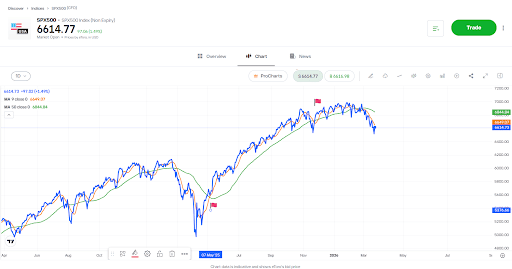
The S&P 500 Index (SPX500) daily price chart below shows the shorter dated 20 day moving average (orange) intersects the 50 day moving average (green). The upwards cross is a bullish signal that an uptrend will form. That trend signal remains in place until the 20 MA crosses the 50 MA to the downside.
Trendline Break Strategy
Trendline breaks occur when price moves through established diagonal support or resistance lines drawn connecting previous price highs, or price lows. These breaks potentially indicate trend exhaustion or reversal.
Trendline break strategy tools:
- Trendlines which connect price highs and price lows and project areas of support and resistance
- Volume indicators which offer an insight into the scale of trading activity near to support / resistance levels.
Common limitations:
- Trendline placement is subjective and varies between analysts
- False breaks can occur before genuine moves
- Multiple valid trendlines can exist simultaneously
Case study of trendline break strategy:
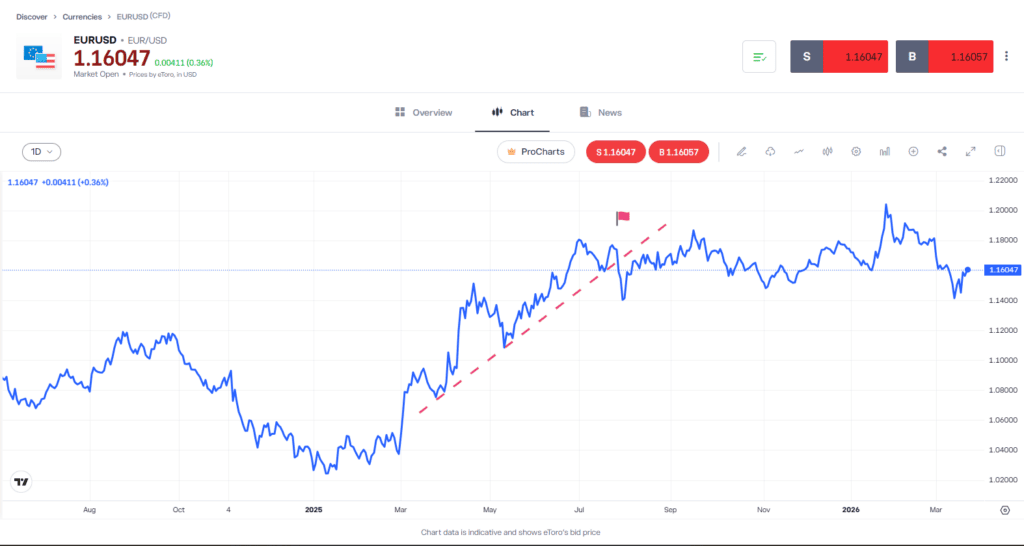
The chart below taken from the Eurodollar (EURUSD) forex market shows a break of an upward trendline which is followed by that trend ending and a period of sideways price movement in a ranging market.
Breakout Strategy
Breakout strategies analyse price movements beyond established horizontal support or resistance levels and into new trading ranges.
Breakout strategy tools:
- Support and resistance lines which market previous price highs, price lows, and other significant price levels.
- Increased trading volumes is typically considered a confirmation signal of a breakout – more traders are behind the move.
Common limitations:
- False breakouts can occur, even when volume indicators signal an uptick in trading volumes.
- Breakouts can retrace to test broken levels
- Range-bound markets might experience multiple failed attempts
Retest Strategies
Retest strategies involve analysing price behaviour when it returns to previously broken support or resistance levels, examining whether these levels hold their new roles. Rather than analysing initial breaks, this approach focuses on secondary tests of significant levels.
Retest strategy tools:
- Analysing price behaviour should it retrace to previous support and resistance levels.
- Can be applied on short positions as well as long positions.
- Consider the number of times a previous support/resistance line was tested before breaking. Many analysts consider more historical tests of a level as a sign that a future retest is more likely.
Common limitations:
- Not all breakouts produce clean retests
- Multiple retests can occur before directional moves
- Timing retest completion remains subjective
Case study of breakout and retest strategies:
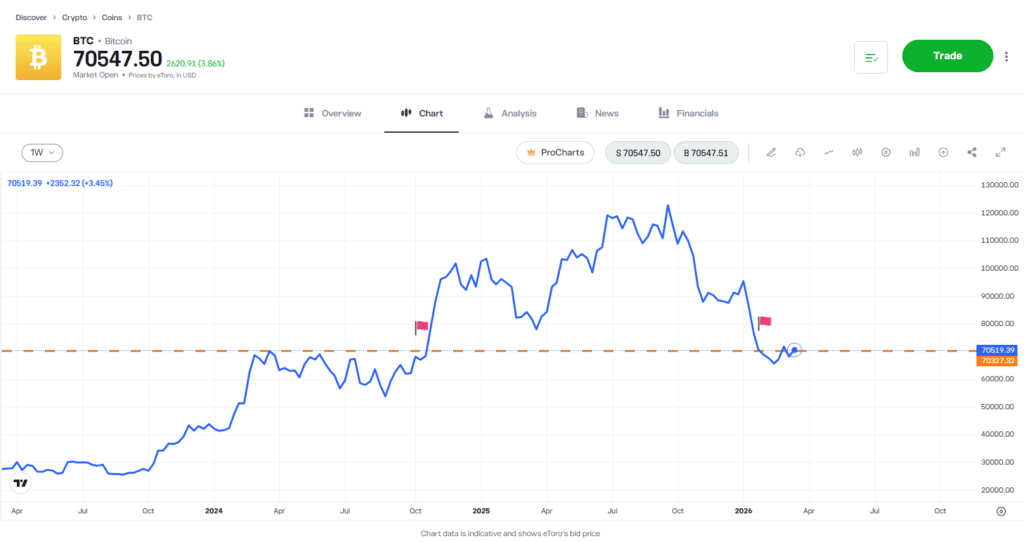
The Bitcoin (BTC) daily price chart below illustrates a breakout scenario following several tests of a key resistance level. At a later date price does return to retest the same price level which previously acted as resistance but now acts as support.
These examples are simplified and for illustrative purposes only; actual liability depends on personal circumstances and local laws.
Tip: Real-world events such as data releases can create additional volatility which can affect the viability of technical indicators.
The relationship between the different strategies and their uses and limitations are outlined in the table below.
| Strategy Example | Market Condition Described | Tools Referenced | What the Signal Represents |
|---|---|---|---|
| Trend Following | Established directional movement | Moving averages, ADX | Alignment of multiple timeframe trends |
| Trendline Break | Trend exhaustion or reversal | Diagonal trendlines, volume | Price moving beyond established angle of ascent/descent |
| Breakout | Range expansion | Horizontal S/R, volume indicators | Price exceeding previous trading boundaries |
| Retest Strategies | Post-breakout consolidation | Price action at former levels | Confirmation of support/resistance role reversal |
Why Use Technical Analysis as Part of a Trading Strategy?
Technical analysis offers a systematic framework for organising market observations.
The tools and indicators used provide structured methods to methodically interpret price behaviour across different market conditions and timeframes.
Other reasons for technical analysis tools being so popular include:
- Range: It is possible to select from a wide range of technical tools and indicators to find those most appropriate for your analysis of current market conditions.
- Market agnostic: Unlike fundamental analysis, which requires asset-specific knowledge, technical tools and indicators function similarly across different markets – from forex to commodities to indices.
- Efficiency: Once you have developed an understanding of a technical indicator it can be applied to strategies regardless of the underlying instrument.
- Risk management: Technical analysis can be used as part of risk management, not just to establish trade entry and exit points. For example, stop-loss limits can be set near to support/resistance levels.

Final thoughts
Technical analysis provides systematic frameworks for understanding market behaviour through historical patterns and indicators, though these tools describe probabilities rather than certainties and no indicator guarantees specific outcomes.
Understanding both the applications and limitations of technical analysis contributes to more informed market study and continuous learning and adaptation remain essential as markets evolve and new patterns emerge.
Visit the eToro Academy to learn more about different forms or market analysis.
Quiz
FAQs
- What’s the difference between technical and fundamental analysis?
-
Technical analysis examines price charts, patterns, and indicators derived from market data, while fundamental analysis evaluates economic factors, company financials, and industry conditions. Technical analysis focuses on price behaviour patterns, whereas fundamental analysis assesses intrinsic value. Many market participants combine both approaches for comprehensive analysis.
- Can technical analysis predict future price movements?
-
Technical analysis doesn’t predict future movements with certainty but rather identifies patterns and probabilities based on historical behaviour. The approach assumes that price patterns tend to repeat due to consistent human psychology, though this assumption has limitations. Past performance and patterns don’t guarantee future results, and unexpected events can override technical signals.
- How many indicators should be used in a strategy?
-
The number of indicators to use depends on the specific analytical approach and type of trading system being applied. Using too many can create conflicting signals and analysis paralysis. Many experienced analysts suggest combining 2-4 indicators from different families to avoid redundancy. Quality of analysis matters more than quantity of indicators.
- What does confluence mean in technical analysis?
-
Confluence occurs when multiple technical factors align at similar price levels or timeframes. For example, a moving average, trendline, and Fibonacci level meeting at the same price area creates confluence. This concept suggests stronger potential significance than single indicators alone.
- Why do indicators sometimes give conflicting signals?
-
Conflicting signals reflect normal market complexity where different aspects show varying conditions simultaneously. A trend indicator might show upward movement while momentum indicators show exhaustion, representing the multifaceted nature of markets. These conflicts often occur during transition periods between market phases.
This communication is for information and education purposes only and should not be taken as investment advice, a personal recommendation, or an offer of, or solicitation to buy or sell, any financial instruments.This material has been prepared without taking into account any particular recipient’s investment objectives or financial situation and has not been prepared in accordance with the legal and regulatory requirements to promote independent research. Any references to past or future performance of a financial instrument, index or a packaged investment product are not, and should not be taken as, a reliable indicator of future results.
eToro makes no representation and assumes no liability as to the accuracy or completeness of the content of this publication.
eToro is a multi-asset investment platform. The value of your investments may go up or down. Your capital is at risk.
CFDs are complex instruments and come with a high risk of losing money rapidly due to leverage. 74% of retail investor accounts lose money when trading CFDs with this provider. You should consider whether you understand how CFDs work and whether you can afford to take the high risk of losing your money.
Cryptoasset investing is highly volatile and unregulated in the UK and some EU countries. No consumer protection. Tax on profits may apply.